
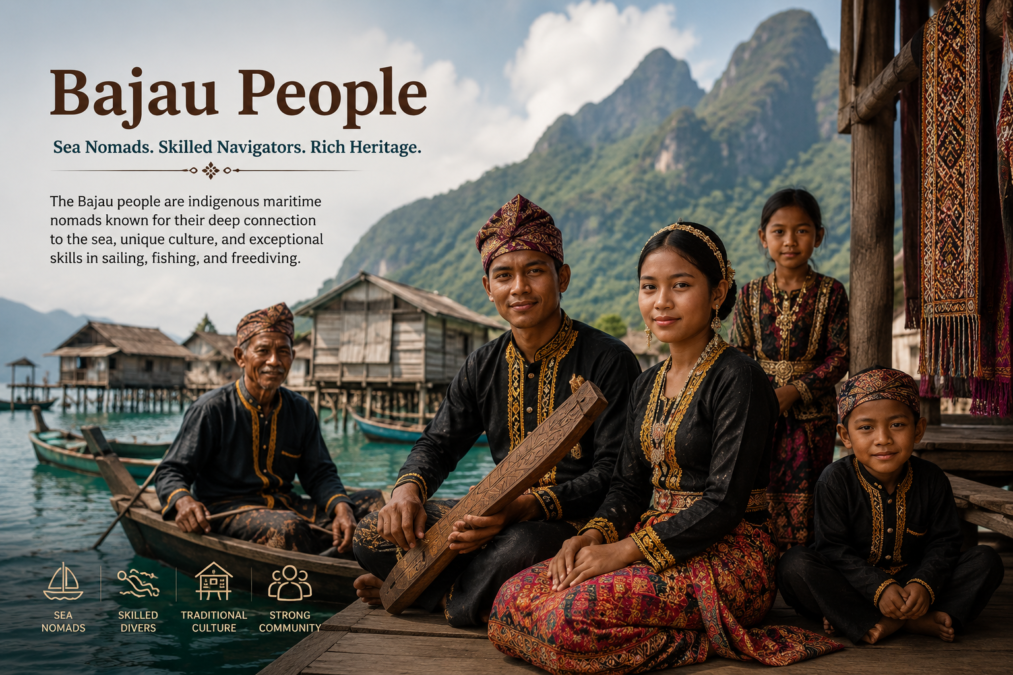

Bajau People are one of the most unique and fascinating communities in the world. Often called “sea nomads” or “sea gypsies,” they have built their entire identity around the ocean. For centuries, they have lived, traveled, and survived on water instead of land, developing skills and traditions that are deeply connected to marine life. Their way of life is not just cultural—it is a complete adaptation to one of the most challenging environments on Earth.
What makes the Bajau especially remarkable is how naturally they live in harmony with the sea. Many of them spend most of their lives on boats or stilt houses above shallow waters. Their connection with the ocean is so strong that even basic survival activities like cooking, sleeping, and raising children are shaped by the movement of waves. Unlike most communities that see the sea as a resource, the Bajau see it as home.
Today, the Bajau continue to exist across parts of Southeast Asia, Bajau People mainly in the Philippines, Malaysia, and Indonesia. While modernization has influenced their lifestyle, many still preserve traditional practices. Their story is not just about survival but about human adaptability, resilience, and a deep cultural bond with nature.
Origins and Early History of the Bajau People
The origins of the Bajau People go back hundreds, possibly thousands of years, rooted in Austronesian migrations across Southeast Asia. Early communities gradually moved from coastal settlements into a fully maritime lifestyle. Over time, some groups abandoned permanent land living altogether and began to live on boats full-time.
Historical references from regional kingdoms such as the Sulu Sultanate mention sea-dwelling groups similar to the Bajau. These groups were often skilled navigators, traders, and fishermen who moved freely between islands. Because they lived on the water, they were difficult to document in written history, which is why much of their early story survives through oral tradition.
Their migration patterns were not fixed like land-based societies. Instead, they followed fish movements, seasonal winds, and ocean currents. This flexible lifestyle allowed them to survive in changing environments and avoid political conflicts on land. The sea was their highway, their home, and their identity all at once.
Over generations, this ocean-based life shaped a unique cultural identity. The Bajau became deeply skilled in navigation, fishing, and underwater survival. Even today, their historical roots are reflected in their traditions, language, and strong connection to the sea.
Geographic Distribution Across Southeast Asia
The Bajau People are widely spread across maritime Southeast Asia. Major populations are found in the southern Philippines, especially in the Sulu Archipelago and Mindanao. In Malaysia, they are concentrated in the state of Sabah. Indonesia also has significant Bajau communities in regions such as Sulawesi, Kalimantan, and the Maluku Islands.
Despite being separated by national borders, Bajau communities share cultural and linguistic similarities. The sea has always acted as a bridge rather than a barrier for them. This allowed continuous interaction between different groups, even across large distances.
Many Bajau live in coastal villages built on stilts above shallow waters. These homes are often close to coral reefs, which provide easy access to fishing grounds. Others still live on traditional boats called lepa-lepa, which serve as floating homes and transportation units.
In recent years, some Bajau have moved inland due to education, government relocation programs, and environmental pressures. However, even those who settle on land maintain strong cultural ties to the sea and often return to it for fishing and traditional activities.
Traditional Sea Nomadic Lifestyle
One of the most defining features of the Bajau People is their sea nomadic lifestyle. In the past, many Bajau families lived entirely on boats, moving constantly across the ocean. These boats were not just transport—they were fully functional homes.
The traditional Bajau boat, known as a lepa, is designed for long-term living. It includes sleeping spaces, cooking areas, and storage for fishing tools. Entire families often lived together on these boats, forming small floating communities that traveled in groups.
Daily life revolved around fishing, navigation, and maintaining the boat. Children learned to swim and dive at a very young age. The sea was their playground, classroom, and workplace. This early exposure helped develop their extraordinary comfort in underwater environments.
Although fewer Bajau today live permanently on boats, the sea nomadic tradition remains an important part of their identity. Cultural festivals still celebrate boat life, and traditional sailing skills are passed down through generations.
Language and Cultural Expression
The Bajau People speak a group of related languages known as Sama-Bajau languages. These languages vary from region to region but share common roots. Despite differences, many Bajau groups can still understand each other due to shared vocabulary and cultural context.
Their language is deeply connected to the sea. Many words describe fishing techniques, boat parts, marine animals, and ocean conditions. This reflects how central the sea is to their daily lives and worldview.
Oral storytelling is a key part of Bajau culture. Knowledge, history, and traditions are passed down through spoken narratives rather than written texts. These stories often include sea legends, moral lessons, and explanations of natural phenomena.
However, modernization is affecting language use. Younger generations often speak national languages like Filipino, Malay, or Indonesian. While bilingualism is common, efforts are being made in some communities to preserve traditional Bajau languages.
Social Structure and Community Life
The social structure of the Bajau People is built around family, cooperation, and shared survival. Extended families often live and work together, especially in fishing activities. This collective lifestyle ensures that everyone contributes to the community’s well-being.
Elders hold an important position in Bajau society. They are respected for their knowledge of the sea, weather patterns, and traditional practices. Their guidance is essential for fishing expeditions and community decisions.
Cooperation is a core value. Fishing trips, boat maintenance, and daily tasks are often shared responsibilities. This teamwork strengthens social bonds and ensures survival in a challenging marine environment.
Even in modern Bajau settlements on land, these communal values remain strong. Family networks continue to play a major role in daily life, and community gatherings remain important cultural events.
Religion and Spiritual Beliefs
The spiritual life of the Bajau People is a blend of Islam and traditional beliefs. Most Bajau communities today practice Islam, which has become the dominant religion in many regions where they live.
However, older sea-based spiritual beliefs still influence cultural practices. Traditionally, the Bajau believed in spirits associated with the sea, wind, and marine life. Rituals were performed to seek protection during fishing or long sea journeys.
Even today, some cultural practices remain tied to these older beliefs, especially in rural or traditional communities. These may include ceremonies before fishing seasons or rituals for new boats.
This blending of religious systems shows the adaptability of the Bajau culture. Instead of completely replacing old beliefs, they have integrated them with newer religious frameworks.
Economy and Traditional Livelihoods
The economy of the Bajau People has traditionally centered on fishing. They rely heavily on the sea for food, income, and trade. Fish, shellfish, and other marine resources form the foundation of their diet and livelihood.
One of their most remarkable skills is freediving. Many Bajau can dive deep and stay underwater for long periods without modern equipment. They use simple tools like wooden goggles and spears to catch fish.
Trade is also an important part of their economy. Bajau communities often exchange fish and marine products with coastal settlers in return for rice, clothing, and other goods. This creates a balanced economic relationship between sea and land communities.
However, modern challenges such as overfishing and environmental damage have affected traditional livelihoods. Many Bajau now work in alternative jobs such as construction, tourism, and wage labor.
Modern Challenges and Lifestyle Changes
The Bajau People today face several challenges that threaten their traditional way of life. Government relocation programs encourage them to settle permanently on land, which changes their relationship with the sea.
Environmental degradation is another major issue. Coral reef destruction, pollution, and declining fish populations make it harder to rely on traditional fishing methods.
Education and modernization also play a role in lifestyle change. While schooling provides opportunities, it often encourages younger generations to adopt land-based lifestyles and national languages.
Despite these challenges, many Bajau communities continue to preserve their identity. Even those living on land maintain fishing traditions and strong emotional connections to the sea.
Cultural Significance in the Modern World
In today’s world, the Bajau People are increasingly recognized for their unique cultural heritage. Researchers and scientists are particularly interested in their freediving abilities and biological adaptations to deep-sea diving.
Tourism has also brought attention to Bajau communities, especially in Sabah and parts of the Philippines. While tourism creates economic opportunities, it also raises concerns about cultural preservation and environmental sustainability.
Efforts are being made to document Bajau traditions, languages, and oral histories. Community leaders and organizations are working to preserve their heritage for future generations.
The Bajau represent a rare example of a living maritime culture that continues to survive in a modern world. Their story highlights the importance of cultural diversity and human adaptation.
Conclusion
The Bajau People are one of the most extraordinary examples of human adaptation to nature. Their deep connection with the sea has shaped their identity, culture, and survival for centuries. Living between water and land, they have created a unique way of life that reflects resilience and harmony with the environment.
Even in the face of modernization and environmental change, the Bajau continue to preserve their traditions and cultural identity. Their story is not just about the past—it is about the ongoing relationship between humans and the ocean.
The Bajau remind us that human life can adapt in incredible ways, and that culture is deeply shaped by the environments in which people live.