
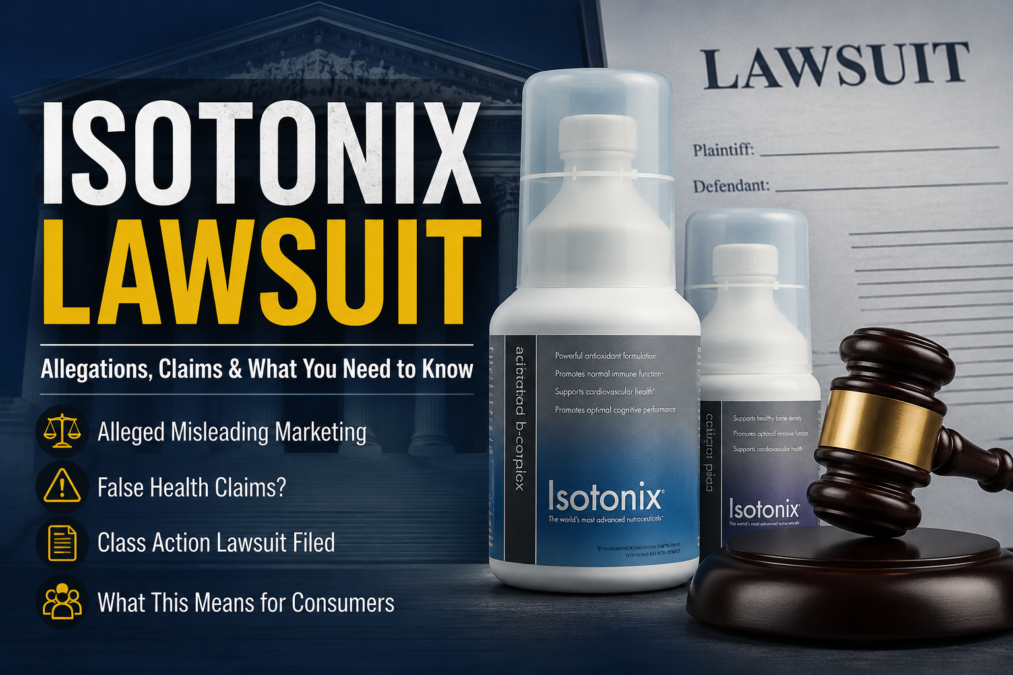

The term “Isotonix lawsuit” has become a popular search phrase among people who want to understand whether Isotonix supplements are facing legal trouble, whether Market America has been sued, and whether consumers should be concerned about the brand. Like many supplement-related stories online, this topic can quickly become confusing because different articles mix together FDA warnings, customer complaints, MLM business concerns, and class-action allegations.
To understand the issue clearly, it is important to separate verified facts from online rumors. Isotonix is a dietary supplement line connected to Market America, a company known for its shopping platform and multi-level marketing business model. The legal conversation around Isotonix is not based on one single simple lawsuit titled “Isotonix Lawsuit.” Instead, the topic mainly involves an FDA warning letter related to certain supplement compliance issues and separate lawsuits or allegations involving Market America’s business structure.
This article explains the Isotonix lawsuit topic in a simple, casual, and fact-based way. The goal is not to attack the brand or defend it blindly. The goal is to help readers understand what happened, why people are searching for it, what the FDA warning actually said, and how consumers can think more carefully before buying or promoting dietary supplements.
What Is Isotonix?
Isotonix is a line of powdered dietary supplements sold under the Market America brand. These products are usually mixed with water before use, and the brand promotes the idea that its delivery system is different from typical tablets or capsules. The official Isotonix website lists products such as OPC-3, multivitamins, B-complex formulas, calcium products, digestive enzymes, and other nutrition-related items.
The brand is marketed in the health and wellness space, which means many consumers discover it while searching for vitamins, antioxidants, energy support, immune support, or general daily nutrition products. Like many supplement brands, Isotonix products are not marketed as prescription medicines. They are dietary supplements, which places them under a different regulatory category than drugs.
This distinction matters because dietary supplements are not approved by the FDA for safety and effectiveness before they are sold to the public. The FDA states that it does not have the authority to approve dietary supplements or their labeling before they enter the market. Companies are responsible for making sure their products follow the law and that their claims are truthful and not misleading.
Why Are People Searching for the Isotonix Lawsuit?
People search for “Isotonix lawsuit” for a few different reasons. Some are customers who want to know whether the products are safe. Others are potential distributors who want to understand Market America’s legal history before joining the business opportunity. Some readers may also have seen online claims about side effects, false advertising, or pyramid scheme allegations and want a clear explanation.
The confusing part is that not every issue connected to Isotonix is actually a lawsuit about Isotonix products. Some concerns relate to FDA labeling and reporting requirements. Other concerns relate to Market America’s multi-level marketing model and income claims. These are different legal and regulatory areas, even though they are often discussed together online.
That is why it is more accurate to say that the “Isotonix lawsuit” topic is a combination of consumer concerns, FDA compliance issues, and Market America-related legal allegations. When writing about this topic, it is important not to claim that a court has proven Isotonix products are unsafe unless there is a verified ruling saying that. Based on the public records reviewed here, the strongest verified product-related issue is the FDA warning letter, not a final court judgment declaring the products harmful.
The FDA Warning Letter Connected to Isotonix
One of the most important verified events in the Isotonix lawsuit discussion is the FDA warning letter sent to Market America in 2020. The FDA said it inspected Market America’s facility in Greensboro, North Carolina, from May 21 to May 28, 2019, and found serious violations of the Federal Food, Drug, and Cosmetic Act and related regulations.
The warning letter mentioned failure to submit serious adverse event reports. According to the FDA, Market America had received reports involving serious adverse events connected to certain products but did not submit the required Serious Adverse Event Reports within the required timeframe. One complaint involved TLS Nutrition Shake, while another involved the TLS 21-Day Challenge Kit, which included TLS Nutrition Shakes, Isotonix OPC-3, NutriClean, and TLS Core products.
This does not automatically mean the FDA concluded that Isotonix caused every symptom described in those reports. A warning letter is not the same thing as a court verdict. However, it does show that the FDA had concerns about the company’s reporting and compliance procedures. For consumers, that matters because adverse event reporting is one way regulators monitor safety signals after supplements are already on the market.
Labeling and Misbranding Issues Mentioned by the FDA
The FDA warning letter also discussed labeling problems. The agency stated that certain products, including Isotonix OPC-3, Heart Health Essential Omega III, Isotonix Multivitamin, Isotonix Multivitamin with Iron, and Isotonix Activated B-Complex, were misbranded dietary supplements because they did not comply with dietary supplement labeling requirements.
One example involved the serving size listed for Isotonix OPC-3. The FDA said the product directions suggested one amount during the first 7 to 10 days but the serving size listed on the label did not match the maximum amount recommended. This type of labeling issue may sound technical, but supplement labels are important because customers rely on them to understand how much they are taking.
The FDA also pointed to other labeling concerns, including nutrition information presentation and botanical ingredient identification. Again, this does not mean a court found the product dangerous. But it does mean the FDA believed the company needed to correct regulatory violations. The warning letter also stated that failure to correct the violations could result in legal action such as seizure or injunction.
Market America Lawsuit Allegations and the MLM Connection
Another major reason the term Isotonix lawsuit appears online is because Market America has faced lawsuits and allegations related to its business model. Market America is not only associated with Isotonix supplements; it also operates through a multi-level marketing structure where independent distributors may sell products and recruit others.
A proposed class action involving Market America alleged that the company operated like a pyramid scheme and that distributors were misled into believing they could earn significant income by selling products and building sales teams. The case was reported as involving RICO claims and false advertising-related allegations. These were allegations, not proven facts in the article reporting them.
The complaint also alleged that distributors had to pay startup fees and ongoing costs, and that many people lost money. According to ClassAction.org’s report, the plaintiffs claimed losses of $35,000, $7,000, and $10,000. It is important to word this carefully: these are claims made by plaintiffs, not a final public ruling that every claim was true.
Why the MLM Issue Matters to Isotonix Buyers
For regular customers, the MLM issue may seem separate from the product itself. A person might think, “I only care whether the supplement works for me.” That is understandable. However, the business model still matters because MLM companies often depend on independent distributors to explain, promote, and sell products.
When products are sold through distributors, there is a risk that individual sellers may overstate benefits, exaggerate income opportunities, or make claims that go beyond what the company officially allows. This is not unique to Market America. It is a broader issue seen across the MLM and supplement industries. That is why regulators and consumer watchdogs often pay close attention to earnings claims and health claims.
Truth in Advertising reported that it found hundreds of atypical and exaggerated income claims connected to Market America’s platforms and that many were later removed after the organization contacted the company. TINA.org also noted that Market America removed the majority of the claims identified in its investigation.
Are Isotonix Products FDA Approved?
A common misunderstanding is that supplements are “FDA approved” in the same way prescription medicines are. That is not how dietary supplement regulation works in the United States. The FDA explains that dietary supplements are not approved for safety and effectiveness before they are marketed.
This means a supplement can be legally sold without going through the same pre-market approval process required for drugs. However, companies still must follow rules. They cannot make false or misleading claims, they must follow labeling requirements, and they must report serious adverse events when required by law.
The Isotonix website itself includes the standard supplement disclaimer that certain statements have not been evaluated by the FDA and that the products are not intended to diagnose, treat, cure, or prevent disease. This disclaimer is common in the supplement industry, but consumers should understand what it means. It means the product should not be treated as a guaranteed cure or medical treatment.
Health Claims, Marketing Claims, and Consumer Expectations
One reason supplement controversies happen is that marketing language can be powerful. Words like “support,” “boost,” “promote,” and “optimize” can sound impressive, even when they do not mean the product has been proven to treat a disease. Supplement companies often use structure/function claims, which describe how an ingredient may support normal body functions.
The FDA allows some structure/function claims, but these claims are not pre-approved by the agency. The manufacturer must have evidence that the claim is truthful and not misleading, and the label must include the required disclaimer. The FDA explains that these claims are different from disease claims, which would suggest that a product can diagnose, treat, cure, or prevent a disease.
For consumers, the best approach is to read supplement marketing with a careful eye. If a product sounds like it can replace medical treatment, cure a condition, or produce guaranteed results, that is a red flag. Even if a supplement has useful ingredients, results can vary based on diet, health status, dosage, medication use, and individual biology.
What Consumers Should Take From the Isotonix Lawsuit Discussion
The biggest takeaway is that the phrase Isotonix lawsuit should not be understood as one simple story. It is a mix of verified FDA compliance concerns, Market America business model allegations, consumer questions, and online commentary. Some online posts may exaggerate the situation, while others may ignore legitimate concerns.
The FDA warning letter is real and should be taken seriously because it involved adverse event reporting and labeling compliance. At the same time, a warning letter is not the same as a final court ruling. It is a regulatory action telling a company that the agency believes violations occurred and that corrective action is expected.
Consumers should also separate product questions from business opportunity questions. Buying a bottle of supplements is one decision. Joining an MLM business and paying fees or expenses is another decision. Both deserve careful research, but they involve different risks.
Should Consumers Be Worried About Isotonix?
Consumers do not need to panic just because they see the phrase Isotonix lawsuit online. However, they should be informed. Dietary supplements can affect people differently, especially if someone has a medical condition, takes prescription medicine, is pregnant, or uses multiple supplements at once.
The FDA warning letter mentioned serious adverse event reports connected to certain products or kits, including one kit that involved Isotonix OPC-3 along with other products. That does not prove that one ingredient caused the reported reactions, but it does show why adverse event reporting matters.
A smart consumer should check the Supplement Facts label, follow the serving directions, avoid combining too many products without guidance, and speak with a healthcare professional when unsure. This is especially important for people with allergies, liver or kidney concerns, heart conditions, digestive problems, or medication interactions.
What Potential Distributors Should Know
For people considering Market America as a business opportunity, the lawsuit discussion should be taken seriously. The proposed class-action allegations focused heavily on income expectations, recruitment, expenses, and whether distributors could realistically earn profits.
Before joining any MLM business, a person should ask for clear income disclosure information, typical earnings data, refund policies, startup costs, monthly requirements, training costs, event costs, and product purchase expectations. A business opportunity should be judged by realistic numbers, not motivational speeches or success stories from top earners.
It is also important to remember that testimonials from successful distributors may not represent the average participant. Consumer watchdogs have repeatedly warned that atypical income claims can mislead people when they are used to promote MLM opportunities. TINA.org’s Market America investigation focused on that exact issue.
Is There a Current Isotonix Class Action Lawsuit?
Based on the public sources reviewed, the phrase “Isotonix lawsuit” is often used loosely online. The clearest verified Isotonix-specific government action is the FDA warning letter involving supplement labeling and adverse event reporting. The broader class-action discussion is more directly connected to Market America’s MLM business structure and distributor claims.
That difference matters. A product-related FDA warning is not the same as a consumer class action proving product injury. A distributor lawsuit about an MLM compensation model is not the same as a court finding that a supplement is unsafe. Online articles sometimes blend these issues together, which can create confusion for readers.
As of this article’s preparation, the safest and most accurate wording is this: Isotonix has been connected to FDA compliance concerns, while Market America has faced legal allegations related to its business model. Consumers should avoid assuming more than the verified record shows.
How to Protect Yourself as a Supplement Buyer
The first step is to treat supplements as products that require research. Do not buy only because of hype, influencer posts, or distributor claims. Look at the ingredient list, serving size, warnings, and whether the product has third-party testing or transparent quality information.
The second step is to be careful with medical expectations. Supplements may support general wellness, but they should not replace medical care. If you are using a supplement for a specific symptom, deficiency, or health condition, it is better to ask a qualified healthcare professional for guidance.
The third step is to document your experience. If you try a supplement and notice unusual symptoms, stop using it and seek medical advice. Serious adverse events can be reported to the company and to the FDA’s MedWatch system. Keeping product packaging, lot numbers, receipts, and dates can also help if you need to file a complaint.
Final Thoughts on the Isotonix Lawsuit
The Isotonix lawsuit topic is not as simple as some online headlines make it sound. There is verified FDA history involving Market America and certain Isotonix-related products, especially around labeling and serious adverse event reporting. There are also separate legal allegations involving Market America’s MLM business model and distributor income claims.
At the same time, readers should be careful not to turn allegations into conclusions. A lawsuit is not proof by itself, and an FDA warning letter is not the same as a final judgment. The fair way to discuss this topic is to explain the concerns, identify what is verified, and avoid making claims that public records do not support.
For consumers, the lesson is simple: read labels carefully, be skeptical of exaggerated health or income claims, and do not treat dietary supplements as guaranteed solutions. For potential distributors, the lesson is equally clear: understand the costs, risks, and realistic earning potential before joining any MLM business.
FAQs About the Isotonix Lawsuit
What is the Isotonix lawsuit about?
The phrase usually refers to a mix of issues, including an FDA warning letter involving Market America supplement compliance and separate legal allegations about Market America’s MLM business model.
Did the FDA ban Isotonix products?
The FDA warning letter reviewed here did not announce a product ban. It identified alleged violations involving adverse event reporting and labeling compliance and instructed the company to correct the issues.
Are Isotonix supplements FDA approved?
No dietary supplements are FDA approved for safety and effectiveness before marketing in the same way prescription drugs are. The FDA says supplement companies are responsible for ensuring their products comply with the law.
Was Market America accused of being a pyramid scheme?
Yes, plaintiffs in a proposed class action alleged that Market America operated like a pyramid scheme. However, allegations should not be treated as proven facts unless a court reaches that conclusion.
Should I stop taking Isotonix products?
This article cannot give medical advice. If you have concerns, side effects, medical conditions, or take medication, speak with a healthcare professional before continuing any supplement.
What should I check before buying Isotonix?
Check the Supplement Facts label, serving size, ingredient list, warnings, product claims, and whether the claims sound realistic. Also remember that supplements are not intended to diagnose, treat, cure, or prevent disease.